Front Lever Progression: How I Got Mine at 6'3" and 205 lb
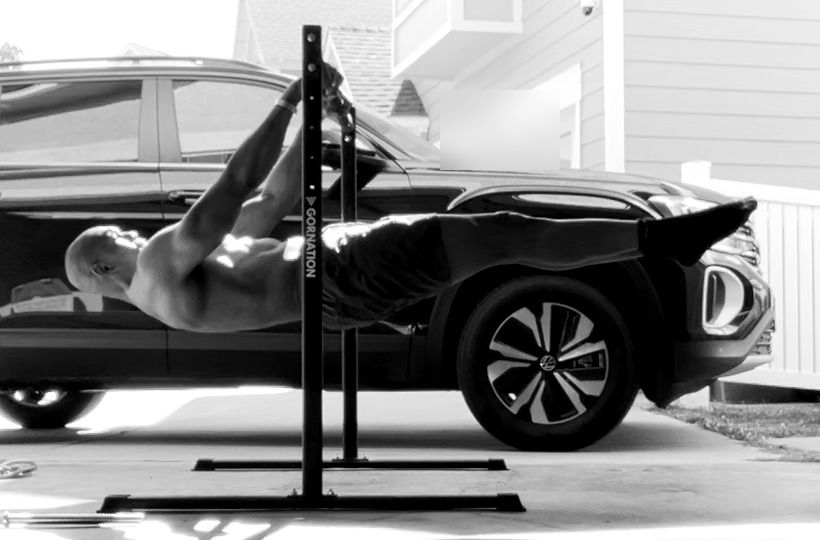
Most front lever advice comes from smaller, lighter athletes. I'm 6'3", and I got my full front lever at 205 lb. Long levers and a heavier bodyweight make this skill harder, so if you're built like me, this one's for you.
I'll be honest up front: I barely trained the front lever directly. Most of my progress came from somewhere else. Here's how it went, what worked, what I'd skip, and how I'd do it if I started over.
Where I started
I didn't start the front lever as a beginner. I'd been doing calisthenics for a year or two. I could already do a weighted pull-up with 70 lb for 5 reps, and I could hold an advanced tuck for about 15 seconds with 5 lb ankle weights on. I weighed around 195 lb.
How it actually went
Getting from advanced tuck to straddle took about 3 months. After that, the front lever turned into a side project. I was dealing with some injuries, and most of my energy was going into weighted pulling and cleaning up my muscle-up. My front lever sessions were usually 30 minutes of attempts, sometimes less.
The straddle was where I got stuck. My hip mobility isn't great, and I tend to pike, so my straddle looked ugly for a long time. I got a clean half lay a month or two after that.
The thing that actually moved it was my main lift. After straining my lat a few years back, I switched to weighted chin-ups for a long stretch, and they didn't do much for my front lever. Earlier this year I switched back to weighted pull-ups. Once I got up to 95 lb for about 6 reps, I went from half lay to a full front lever in roughly 2 to 6 weeks. By then I was 205 lb.
All in, advanced tuck to full took me about a year, with very little direct training.
The benchmark I look at first
When I coach someone on the front lever, I look at three things: what progression they're on, how their form looks there, and how strong their pull is. Bodyweight pull-up reps tell me something. Weighted pull-ups tell me a lot more.
From what I've seen, once you can pull about half your bodyweight added for 5 reps, the front lever gets a lot easier to train directly. That lines up with my own numbers: 95 lb at 205 lb bodyweight is close to half. You can check where you're at with the 1RM Calculator and the Strength Tier tool.
The progressions I'd use
My rule for moving on is simple. When you can hold a progression comfortably for 8 to 12 seconds, with clean form and no shaking, you're ready for the next one.
Tuck. Knees to your chest, back flat.
Advanced tuck. Open your hips to about 90 degrees and keep your back flat.
Advanced one leg. One leg straight, the other in an advanced tuck. I use this one on lighter days.
Half lay. For me, this was the closest thing to the full front lever. I use it on heavy days.
Full front lever.
You'll notice the straddle isn't on that list. Unless you have the hip mobility for it, I'd skip it. Once your hips get tired, your body line breaks, and you end up practicing a bad position. If you do want to work toward it, bands or a half straddle bridge the gap well. The half straddle sits between the advanced tuck, the straddle, and the half lay, so you get a bit of everything. If you can hold a half straddle for about 10 seconds, you should be able to hold a decent straddle for at least 3.
One more drill I'd put near the top of the list: advanced tuck front lever rows. Along with the half lay, nothing carried over more for me.
How I train it now
If I started over, I'd train it the way I do now, 2 to 3 times a week:
- 2 sets of full front lever attempts
- 2 sets of band-assisted full front lever
- 2 to 3 sets of an easier progression: half lay on heavy days, advanced one leg on lighter days, and straddle every now and then
- 2 sets of advanced tuck front lever rows. I keep these low because I'm still training heavy weighted pull-ups.
- 2 to 3 sets of front lever raises or presses, at the hardest progression I can control (right now that's the half lay). 4 sets at most.
What I'd tell myself back then
The biggest mistake I made was training the front lever like a weighted pull-up or a heavy squat. It doesn't work that way. Stop every hold with a couple of seconds left in the tank, and end it before your body line breaks. If your form starts slipping, drop to an easier progression instead of holding on. Holding a bad position doesn't build a good one.
Rest at least 2 minutes between sets.
I also train it away from my heavy days. Most people do their front lever right before their weighted pull-ups and dips. I usually do it the day after. If it has to be the same session, I pick an easier progression I know I can hold after heavy dips.
And one tip a coach gave me that stuck: train the front lever by feel. It shouldn't feel like grinding out a max squat.
Protect your elbows and shoulders
Your triceps work a lot harder in the front lever than people give them credit for, and the triceps tendon can get irritated. Strong triceps go a long way toward protecting your elbows.
Keep your shoulders neutral, with a slight pull back, but not fully retracted. Squeezing your shoulder blades all the way together takes your lats out of it, and the lats are what hold you up. And don't let your shoulders round forward either. Protracting them puts a lot of strain on your neck and upper traps.
Keep an eye on your biceps tendon too. I had some biceps tendon irritation earlier this year, but it had nothing to do with the front lever. It came from the form I was using on weighted dips, and the volume on weighted chin-ups added to it, since chin-ups load the biceps more. The front lever loads that same area, though, so if it's already irritated, ease off.
Stuck at the advanced tuck?
Build your pull. Get better at inverted rows, especially on rings. Work toward chest-to-bar pull-ups. Build up your rear delts and your shoulder retraction. And add weight to your pull-ups. If you don't have weights yet, wide-grip pull-ups are a great option, since they put more emphasis on retraction, which carries straight over to the front lever.
Where I'm at now
Right now I can hold a clean full front lever for about 4 to 6 seconds. I'm working on getting it to 10, and after that, front lever pull-ups.
If you want your front lever built into a program alongside your strength work, that's what my coaching does. See how I coach skills like the front lever and muscle-up, or book a free call and we'll figure out where you're at.